


English
September 25, 2026The Right-Wing Smear Campaign Against the Left Party in Berlin
The original article was published in German by the author Fabian Lehr on his personal page on September 25, 2026.
In September, the reformist Left Party (Die Linke) became the strongest party in the Berlin elections. Leading up to the elections, a right-wing smear campaign against the party took place. This smear campaign intensified after the Left Party won and mainly scandalized that parts of the base of the Left party unequivocally reject Zionism, are against the genocide in Gaza and demand socialization of the housing sector. The opportunistic response of the leadership of the Left reformist party shows the limitations of reformist politics in trying to co-manage the capitalist state.
Guest article by Fabian Lehr
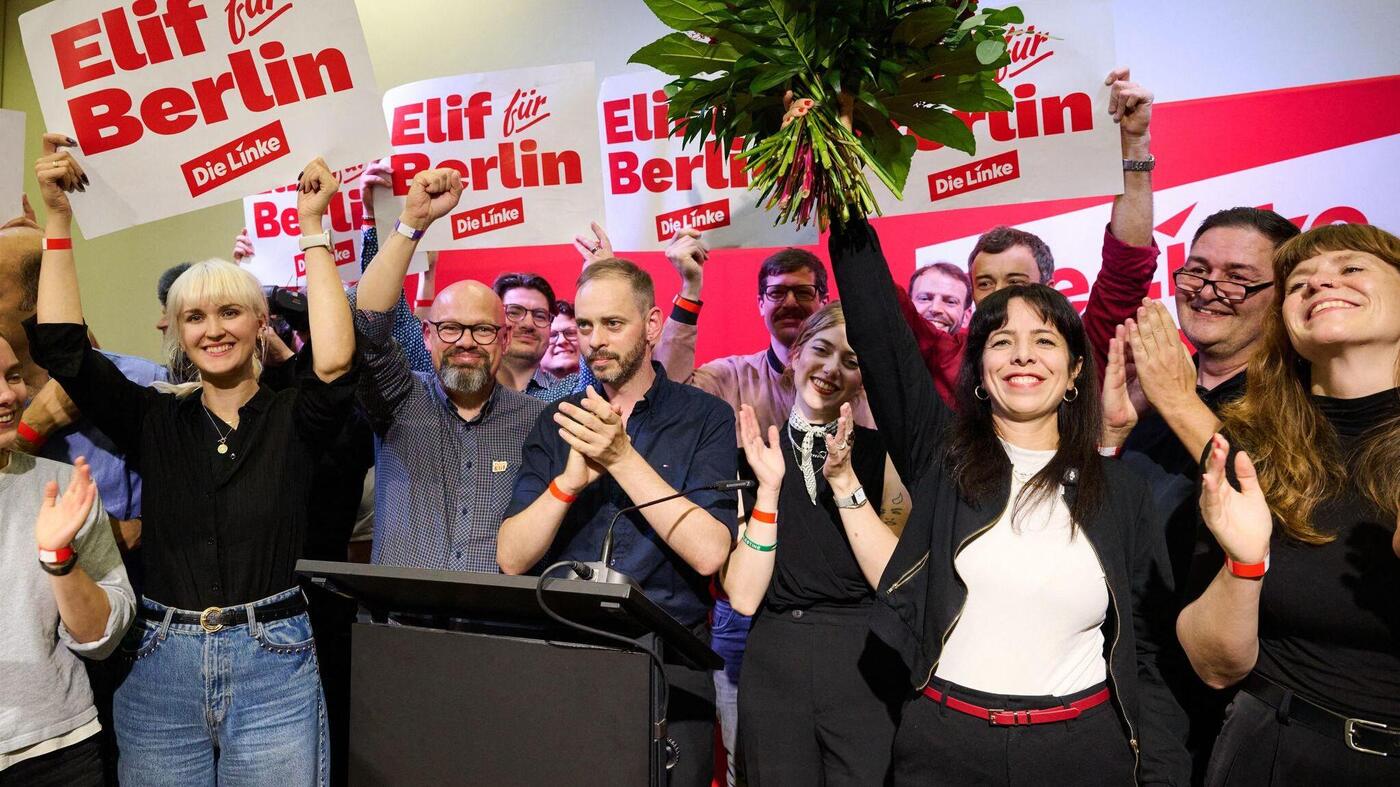
Actually, the Left Party would have reason to celebrate, at least in Berlin (less so in Mecklenburg-Western Pomerania): With 25.7%, it has become by far the strongest force in the capital—far exceeding all projections—and has achieved one of the most spectacular results in the party’s history.
Among young voters under 35, it came close to an absolute majority; in the Neukölln 2 district, it actually secured an absolute majority. In the conservative political and media world—from Springer to the Greens—this result, however, triggered a mixture of panic and seething rage, as well as an all-out smear campaign against the Left Party, casting doubt on Elif Eralp’s dreams of a red-red-green coalition.
This smear campaign has so far comprised three phases—or, since several of them occurred simultaneously, three thematic blocks. On the one hand—predominant especially in the days BEFORE and then immediately AFTER the election—there was panic among the parties and media of the capitalist class over the threat of expropriation of real estate corporations in Berlin, accompanied by grim warnings of massive capital flight and the onset of Cuban-style conditions in the capital. This aspect of the campaign, however, soon receded into the background, perhaps based on the obvious consideration that the struggle against real estate capital in a city where roughly 85% of residents are renters and the housing market is insanely overheated—to the point where even dual-income couples have difficulty finding an affordable apartment—doesn’t really serve as a bogeyman suitable for discrediting the Left Party.
The second component is the personal smear campaign against Neukölln’s Member of the Bundestag, Ferat Kocak, due to his alleged ties to criminal organizations. Issa Remmo appeared at the Die Linke Neukölln election party; although he has not been legally convicted of any crime, he is suspected of heading a mafia-like organization that is regularly referred to in the media—in a strongly racially charged manner—as the “Remmo clan.” Remmo had his picture taken there with Kocak and expressed his sympathy for The Left Party, which the reactionary press promptly spun into the claim that “The Left Party is a clan-based party mired in a mafia-like quagmire.”
Now, this election party was an open event that anyone could attend at will and without an invitation, and Remmo was apparently asked to leave the celebration shortly after some participants identified him—but in the ensuing media firestorm from the right-wing press, no one cared about that anymore, nor about the juicy fact that, in contrast, CDU politicians had in fact already invited him to joint official talks. For Springer, the CDU, and the AfD, it was now clear that the Left Party—and in particular its notorious Neukölln district chapter—was a gangster party in league with sinister Arab criminals, and anti-communist hatred of leftists combined with racism—sometimes more, sometimes less subliminal—not only toward Remmo but also toward Kocak—especially when, shortly thereafter, chat logs were published suggesting that Kocak had previously been in contact with Remmo’s relatives.
The third—and soon entirely dominant—component of the anti-Left smear campaign was, ultimately, the accusation of anti-Semitism: The Left Party—and, once again, its Neukölln district chapter in particular—was portrayed as a hate-filled, anti-Semitic mob with whom decent liberal democrats could not work. This accusation, in particular, was not only leveled in increasingly insane attacks by the Springer press, Nius, the AfD, the CDU, and others, but also by the Left Party’s potential coalition partners in Berlin—the SPD and, especially, the Greens. Several leading Green Party politicians publicly demanded that The Left first expel all anti-Semites from the party before coalition negotiations could even be considered.
One must really take a moment to consider this situation: A party with 14% of the vote slanders a party with 25%—with which it potentially wants to form a coalition as a junior partner—first as a hotbed of anti-Semitism, and then demands that a precondition for any coalition be the expulsion of all party members of the senior partner whom they dislike, a demand subtly directed once again primarily against Die Linke Neukölln; in other words, they are simply demanding, on the basis of unfounded slander, that the winning party—which is nearly twice as strong—destroy what is perhaps its most popular and successful district chapter in all of Germany. For “slander” is the term that must be used here. In the vast majority of cases, these frenzied attacks on Die Linke’s alleged anti-Semitism are made without any concrete evidence, let alone any willingness to engage in a discussion of what anti-Semitism actually means.
In most cases, it soon becomes clear that “anti-Semitism” here simply refers to sharp criticism of the State of Israel and its crimes, or to describing Israel’s actions in Gaza using the term “genocide”—a term that is very common in both the international media and politics. It is simply a repetition of the religious mantra of the Church of West German state raison d’état, which holds that opposition to the State of Israel and anti-Semitism are synonymous. No evidence whatsoever of actual anti-Semitism—of hatred toward Jews or criticism of Israel specifically because of its Jewish character—can be found in this farce.
A steadfast, self-assured left-wing party would counter that Judaism and the State of Israel are simply two completely different things, that no criticism of this state—no matter how sharp or fundamental—is anti-Semitic per se, and that the loudmouths at Springer, the AfD, the Greens, and the like must either provide concrete evidence of anti-Semitic motives behind criticism of Israel by representatives of Die Linke or immediately cease their outrageous insults against our comrades. It would counter that, according to all available studies, actual anti-Semitism is much rarer among leftists than among right-wingers, and that classic anti-Semitic statements are shared much more widely by AfD, CDU, and even SPD voters than by Die Linke voters, as was just recently demonstrated again in a 2025 study.
She would counter that a study by the University of Mannheim has just shown that, on the contrary, there is a NEGATIVE correlation between criticism of Israel and anti-Semitism in Germany: Classically anti-Semitic ideas are particularly popular among people who share the Federal Republic of Germany’s official mantra of unconditional solidarity with Israel, whereas among leftists with a very negative attitude toward the State of Israel, classically anti-Semitic ideas are least popular—as is practically demonstrated by the fact that the AfD and the Union, that is, the two major parties that, both ideologically and in terms of personnel, are most closely aligned with the legacy of German fascism, preach the most fanatical solidarity with Israel. She would counter that left-wing Jews play a major role, particularly in Berlin’s Palestine solidarity movement, and that it is precisely these left-wing Jews who are regularly harassed by the police of the successor state to the Third Reich for their lack of loyalty to the State of Israel under the banner of the “fight against anti-Semitism.”
Above all, she would counter that, as Berlin’s strongest political force with a clear voter mandate, one must reject such audacity toward one’s own comrades, that it stands in one hundred percent solidarity with them until any actually anti-Semitic positions are proven, and that it, for its part, makes respectful treatment of its own people (yes, including those from Neukölln) a prerequisite for any political discussions with the Greens, the SPD, and others. Unfortunately, the conduct of the Berlin Left Party leadership raises serious doubts as to whether the Left Party is such a steadfast and self-assured force.
A foretaste of this came shortly before the elections with the scandal surrounding musician Dahabflex’s performance at a festival organized by Die Linke Neukölln, where he chanted slogans against the Israeli armed forces and, as a result, faced a personal smear campaign from the bourgeois mob. Instead of standing behind Dahabflex and the Neukölln comrades and making it clear that anti-Semitism and opposition to the Israeli state apparatus—and especially its armed forces—are two different things, Elif Eralp caved to the campaign by issuing a statement distancing herself from those under attack.
This reaction confirmed once again that such smear and defamation campaigns against the Left Party are obviously worthwhile, because under reactionary pressure, the party very quickly softens and jumps to heel as ordered. Even in the much more intense current backlash against the party’s left wing, the response from Eralp and her circle has so far been very weak; there is little sign of a strong public show of solidarity with those under attack, let alone a clear message to the Greens demanding an apology for their insolence toward the party’s own membership. The impression the Berlin leadership of The Left is currently giving is that they don’t want to scare off the Greens and the SPD as coalition partners at any cost—and that, when in doubt, they care more about what the bourgeois press and parties think of them than what the left wing of their own base thinks.
It’s actually an absurd situation: the very fact that The Left—especially in Berlin—is perceived as the only major party that is truly critical of Israel is a not insignificant factor in its success. Contrary to what the frenzied media discourse on the subject might suggest, solidarity with the State of Israel is an extremely unpopular position among the general population. A steady 70–85% of the German population has rejected military support for Israel in polls over the past two years; the state’s popularity has hit rock bottom since the destruction of Gaza; and Netanyahu and his fascist-like government are widely perceived as despicable criminals. There is no political issue in Germany where the gap between public opinion and the media’s portrayal of that opinion is as vast as it is regarding Israel and Palestine. Since the Left Party has managed, over the past year or two, to bring itself to adopt somewhat clear positions in solidarity with Palestine, and, especially in Berlin, it has thereby gained enormous popularity, particularly among migrants whose families come from Muslim countries and for whom it is a relief, amid the sea of Islamophobic hate speech from the bourgeois parties and media, to finally see at least ONE major party for which Arab lives are valued. Candidates such as Ahmed Abed, Martha Kleedörfer, Deike Janssen, and Vanessa Emde have performed spectacularly well in Berlin precisely BECAUSE they are perceived as uncompromising critics of Israeli crimes.
Any distancing from this left-wing, pro-Palestinian faction of the party is bound to undermine the very foundations on which Die Linke was able to become Berlin’s strongest party in the first place, not to mention that yielding to external pressure from the right always signals weakness, which is bound to make one look contemptible in the eyes of one’s own base and invite further and even more intense attacks—attacks that are clearly working.
This is all the more true given that it is clear the Left Party’s alleged anti-Semitism is merely a pretext for this campaign. Who would believe that the AfD—which is riddled with militant neo-Nazis—is actually concerned with fighting anti-Semitism? Who can buy the claim that the Union—the party of Hans Globke, Kurt Georg Kiesinger, and Hans Filbinger, a third of whose voters agree with the statement that it is a problem that Jews have too much power in the world, and whose chancellor evidently regards German Jews as a foreign people—is outraged by left-wing anti-Zionism because it suspects anti-Semitism lurking behind it? Who believes the right-wing hate rags of the Springer press—the mouthpiece of the beneficiaries of “Aryanization” within German monopoly capital—when they claim to be nobly and humanistically committed to fighting hate and incitement?
It is obvious that this campaign is, to a large extent, simply direct or indirect lobbying on behalf of real estate capital, which fears that a Left Party-led Berlin city government could put a damper on its booming profits derived from exploiting the capital’s tenants—and therefore wants to discredit the Left Party at all costs and prevent a red-red-green coalition. Whether the Greens and the SPD even want such a coalition at all seems highly questionable anyway, given their brazen attacks on The Left in recent days—much suggests that they are signaling a willingness to form a coalition only pro forma, but actually prefer a CDU-led coalition, confirming once again that, when in doubt, the Greens and the Social Democrats would rather submit to a right-wing force than to a truly left-wing one.
And if, along the way, they could smear their rivals on the left and put them in a position where they’d have to discredit themselves even in the eyes of their own base, so much the better. Both the harshness and excessiveness of the right-wing attacks on the Left Party and the extremely weak reactions to them so far from Eralp and Co. certainly give little cause for optimism—even if a red-red-green coalition were to actually materialize—regarding the Left’s steadfastness in defending red lines against the Greens and the SPD during coalition negotiations. And in a more general sense, the madness of the last few days once again highlights the limits of reformism: If the German bourgeois reaction is responding in such a frenzied manner to the success of a party that, at the end of the day, is merely a moderate left-reformist party at the state level—what would happen if we in Germany once again had a truly communist mass party at the national level? How likely would it be that the German bourgeoisie would simply accept THEIR electoral victories and any subsequent formation of a government peacefully?


