


English
September 8, 2026What fans the flames of the fascist AfD Party in Germany?
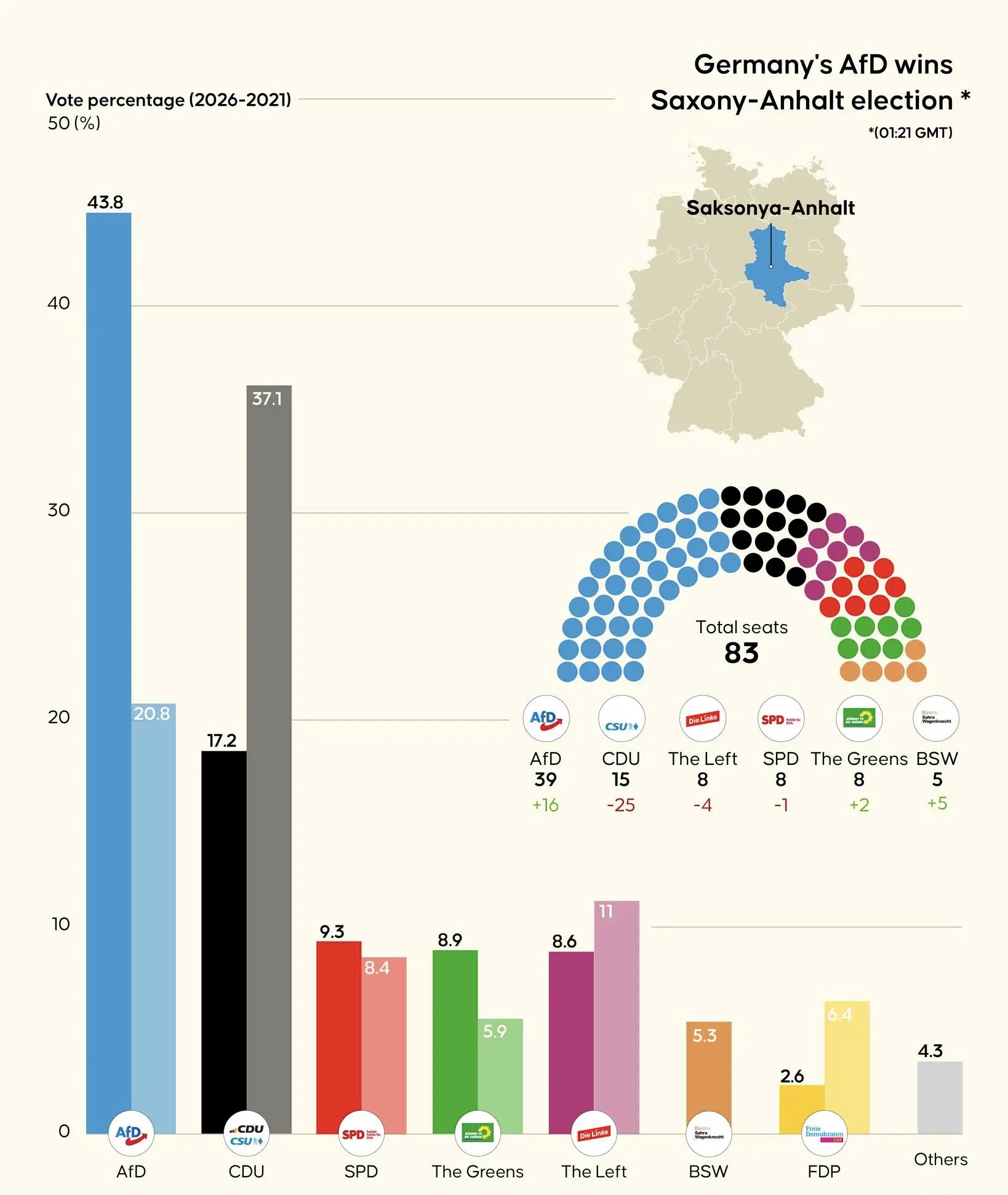
The fascist Alternative für Deutschland (Alternative for Germany) Party emerged as the strongest force in state elections in the Eastern German state of Saxony-Anhalt on September 6, winning a landslide victory with 44% of the votes. These are the best results fascists have gotten since the Nazi dictatorship. Why is the AfD so strong, what is it, and how can antifascists confront it?
By Omnia Magdy
The Election Results
In the weeks running up to the state elections in Saxony-Anhalt, polls had shown that the Alternative for Germany (AfD) would come out as the winner of the elections. With a staggering 44% of the votes, the party won over 23% extra votes from the previous state elections in 2021. The Christian Conservative Union (CDU), which ruled Saxony-Anhalt for most of the last 36 years, lost almost 20% of its previous votes, landing it at 17% in this election. The reformist Left Party (Die Linke) lost 2,4%, landing it at 8,6%, while the Social Democrats (SPD) received 9% of the votes (up by 1% since 2021); the Greens (Die Grünen) received 8,9% (up by 3,9% since 2021); and the socially conservative split from Die Linke, Bündnis Sahra Wagenknecht (BSW) received 5,3% of the votes.
Statistics show that the majority of people who voted for AfD in this election were previous non-voters, making up a total of 170,000 people. The other main thrust who voted for the AfD came from former CDU-voters, making up 82,000 people; 19,000 coming from the Liberal Conservatives (FDP); 11,000 from Die Linke; 7,000 from SPD; and 2,000 from the Greens.
With 2.14 million inhabitants, the state was formerly part of the Eastern-Bloc German Democratic Union (DDR). As with other Eastern German states, since reunification with Western Germany, living standards have been worse than in the West and have gone even further downhill in recent years.
Chances are high that the AfD will build a minority government, as no other parties have publicly said they would go into coalition talks with the AfD. Although the socially conservative BSW has repeatedly stated that it would be willing to work together with the AfD in one way or another, it has not said that it would go into a coalition. Simultaneously, politicians from the CDU, SPD, Greens and Left are debating whether a coalition of “democratic forces” should be built to hinder the AfD from ruling Saxony-Anhalt. Such a coalition would be fatal for Die Linke. Not only would Die Linke be implementing racist policies like deportations in such a coalition, as it has before in other co-run governments, but it would also (again) co-manage the bourgeois state, implementing the same austerity measures that fanned the flames of the AfD in the first place.
Massive AfD Gains in Previous State Elections
The AfD has been on the rise for quite some time now. In the German parliament (Bundestag) in Berlin currently the AfD has 152 seats in the German parliament, having won 20,8% of votes in the February federal elections in 2025. The ruling government of Christian Conservatives (CDU) and Social Democrats (SPD), led by Chancellor Friedrich Merz, faces the AfD as the strongest oppositional force in parliament, where Die Linke only has 64 seats and the Greens 85 seats.
In September 2024, state elections were held in the Eastern German states of Thuringia and Saxony. In Saxony the AfD won 30,6% of the votes, while in Thuringia they won 32,8% of the votes. Fascists had not been this strong since the 1930s, when Hitler’s NSDAP won 33% in the federal elections in 1932.
In the state elections in Thuringia, the votes for the AfD increased by 7,1%, making it the strongest party in Thuringia. The reformist Left party (Die Linke), which used to be the strongest party and ruled the state under the government of Minister President the Zionist Bodo Ramelow from 2014 to 2024, lost 18,5%, receiving only 12,5% of the votes in 2024.
In Thuringia, a very fragile minority government coalition of CDU, SPD, and BSW was formed in 2024, while in Saxony a minority government of CDU and SPD is ruling. Both states see the AfD as the strongest opposition party in the state parliament.
What is the AfD
When the AfD was founded in 2013, the party initially aimed to leave the Euro currency and re-establish a national currency. This attracted a broad coalition of Euro skeptics, national liberals, and economic liberals, unified in demanding less state, less social security, and overall more unbridled capitalism. In 2013, it was unclear which forces would propel this new party. Since then, it has become a fully-fledged fascist party. Hereby, one of the party leaders and a member of the state parliament of Thuringia, Björn Höcke, has played a pivotal role.
Höcke is infamous in Germany for his speeches, in which he often uses Nazi rhetoric. Notably, in 2015, he co-founded a caucus in the party called “The Wing” and organized to position the party further to the right. While Höcke immediately made headlines through racist, Islamophobic, sexist, homophobic, and transphobic remarks, others were more careful and worked in the background to cement the Wing’s influence against the economic conservatives within the party.
As more refugees from Syria and Afghanistan came to Germany since 2015, the AfD was able to capitalize on their racism and islamophobia. The racist AfD ideology, which forms the backbone of the party, crept into the politics of all established parties, fueling divisive hate. One then high-ranking politician of the AfD, Frauke Petry, in 2016 even suggested shooting refugees at the borders.
Under Angela Merkel in 2015, the general sentiment in Germany was, “We can do this.” In the last decade, the discourse has shifted extensively to the right, and mainstream political opinion is to strengthen borders and build a “Fortress Europe.” This is also thanks to AfD politicians, who always sought center stage to platform their racist bigotry and were ultimately backed by the laws made by the Social Democrats, Liberals, Christian Conservatives, Greens and occasionally Die Linke.
Although “The Wing” has officially been disbanded since 2020, it should be common knowledge by now that Höcke and other AfD cadres are extremely well connected with the old Neo-Nazi milieu nationally as well as internationally, which helps them in their efforts to secure donations and organize street terror. In 2018, Höcke, his AfD wing, and open Neo-Nazis led marches through the city of Chemnitz, where pogrom-like attacks on refugees and migrants took place in broad daylight. The AfD openly supports and has built up the far-right, Islamophobic Pegida movement in Dresden as well, which, in typical white supremacist jargon, warns of a “great replacement” in Germany. Right now, the AfD uses its connections in the Neo-Nazi milieu to build up small thuggish street groups here and there to instill fear, especially in rural areas in former East Germany.
Some of the closest affiliates of the head of the AfD lead candidate in Saxony-Anhalt, Ulrich Siegmund, were active in the neo-Nazi organization “Heimattreuer Deutsche Jugend” (HDJ), which was banned in 2009.
So far, the AfD has not built up a nationwide paramilitary militia like Hitler’s Nazi Sturmabteilung (Storm Division), but the level of violence is constantly increasing. If the German capitalist class sees the necessity for a fascist seizure of power to crush a more militant working class, fascist paramilitary militias will be indispensable. For now, this is not *yet* the case, as the bourgeois parties are still able to keep the status quo in check and we do not have a strong militant workers’ movement that threatens the capitalist class as we had in the 1920s and 1930s in Germany. But the pogroms in Chemnitz in 2018 serve as a clear warning of what the fascists are capable of. History does not repeat itself, and it would be gravely mistaken to downplay the threat that the AfD poses due to obvious historical differences between now and the rise of the Nazi Party NSDAP over 90 years ago.
Yet this does not mean that leading members of the AfD constantly make public comments that positively draw on the Nazi dictatorship. On the campaign trail in Saxony-Anhalt, videos circulated of AfD lead man Ulrich Siegmund yelling to a crowd of supporters at a rally “Sieg,” to which the crowd called back “Mund”. The reference to calls of “Sieg” and “Heil”, the victory salute used at political rallies by the Nazis, was obvious. When asked about this, Ulrich Siegmund smugly declared that his name is “Siegmund” after all; what else should he say? Other high-ranking members of the party have made abundantly clear that they view the Nazi dictatorship in Germany as but a small fraction of Germany’s history. With slogans that “we should be proud to be German again” and revamping “love for German homeland,” the AfD is able to emotionally conjure reference points to Nazi propaganda.
Over time, this increased emphasis on far-right policy-making and organizing made the more parliamentary-focused but not fascist members leave the party; examples include the former party leaders Frauke Petry and Jörg Meuthen. Some of the party conservatives, who previously had provided a bourgeois-democratic cover for the fascist wing, were even actively bullied out by Höcke and his supporters. Due to the rising influence of Höcke’s Wing within the party, with its clear Nazi rhetoric, fascist political proposals, and active efforts to establish street terror, the party has consolidated itself as a fascist party.
The AfD is also a deeply pro-zionist party. A few days prior to the party assembly in Riesa, Alice Weidel, in an interview with Elon Musk, said that a Palestinian-leftist conspiracy is following the antisemitic legacy of Adolf Hitler, who she claims was actually a communist. This vile historical revisionism is startling but not surprising if one looks at the way that fascists from the AfD have been claiming for years that Muslim and Arab immigrants are to blame for anti-Semitism in Germany. The AfD has staunchly supported Israel’s genocidal war, while purporting that the Nazi dictatorship was mere “birdshit” of history.
Although the established bourgeois German parties claim that they don’t want anything to do with the AfD, in January 2024 it was revealed that ties are closer than they would like to admit.
Deportation Plans of Non-White People from Germany
Research by the reporter collective Correctiv showed that a secret meeting of high-ranking right-wingers took place near Potsdam in the East German state of Brandenburg in November 2023, where they laid out a plan to cleanse Germany of non-white people. Journalists infiltrated the secret meeting in Potsdam where AfD cadres tried to make plans for the mass deportation of refugees, German citizens with a “migrant background,” and anyone deemed “non-German.”
This meeting shed light on the fascist ideology of AfD’s plan to institute a reign of terror. The two dozen attendees of the secret meeting included not only AfD members but also members from the conservative Christian Democratic Party, members of the fascist Austrian Identitarian Movement (fascist Martin Sellner held the keynote speech), and members of the Union of Values (Werte Union). Ulrich Siegmund, co-chairman of the AfD parliamentary group in the state legislature of Saxony-Anhalt and who will most likely be the new Minister President of Saxony-Anhalt, was also present at this meeting.
At the meeting, the fascist “remigration plan” was drawn out, depicting the plan to deport 20 million people to North Africa. All those whom the fascists do not define as Germans, regardless of whether they have German citizenship or not. The overall concept represents a “master plan”, whereby the “biggest problem”, the fascists at the meeting claim, is those people in Germany who are not “pure Aryan Germans” but have a German passport.
In order to make the deportation of 20 million non-white people from Germany possible, the fascists at the meeting laid out that they want to adapt laws to make life as “unattractive” as possible for non-white people in Germany. Eerily, then parliamentary group leader in Saxony-Anhalt Ulrich Siegmund stated that he wishes to put migrant restaurants under pressure to make life more “unattractive.”
Only about 8 kilometers from the site of the Wannsee Conference, where the extermination of European Jews was planned, Sellner’s “master plan” is reminiscent of the Nazis’ Madagascar plan of 1940, which proposed the deportation of 4 million Jews to Madagascar. But it is also reminiscent of the Nazis’ “Nuremberg Race Laws” and the “unattractiveness of life” and the terror of the paramilitary structures of the SA and SS.
These revelations sparked public outrage with protests across the country. Yet these protests did not have longevity. And instead of showing a clear profile against the fascists, ruling parties have time and again made concessions to the racist demands of the AfD, passing racist policies, while simultaneously, through drastic austerity measures, fanning the social flames that give the AfD power.
What fuels the flames of the AfD?
Deep economic and political crises form the background of the AfD’s successes. Massive budget cuts in all sectors of society and worse living conditions in the context of unprecedented hikes in military spending have worsened the living standards for the German working class.
“Social security” and “peace” were listed as the two main factors that influenced voting decisions by people in Saxony-Anhalt. After all, the federal government is responding to the long-standing cost-of-living crisis with further measures that exacerbate social hardship. 42 percent of all pensioners already have to make do with a poverty-level pension of less than 1,000 euros. As the ruling parties have implemented drastic pension cuts and slashed spending on long-term care and healthcare while ramping up military spending, they have lost all credibility in being able or willing to implement policies of social security and peace. A record-breaking 61% of workers voted for the AfD in the elections in Saxony-Anhalt, while Die Linke received an all-time low of working-class votes.
The AfD is by no means a “peace party”, as they have supported the genocide in Gaza since the beginning, are for military conscription, support Nato, increase spending for the arms industry and are not against armament, even demanding more funds for the German military. Nonetheless, as an oppositional force they are able to score points against the militarization frenzy of the government and paint themselves in a different light.
This fits into the anti-establishment narrative of the AfD, in the context of the economic policies of the bourgeois parties creating a fertile ground for the fascist AfD to gain support.
While economic hardship does not make people vote for a fascist party, it is a mixture of the ruling parties’ austerity policies together with the normalization of racist scapegoating of migrants, refugees, Muslims, and non-white Germans that has given the AfD an astronomical rise in voter support. For much of the German ruling class, scapegoating migrants and refugees as the cause of problems in Germany has been a useful tool to distract from the fact that it is the ruling class’ policies that make life miserable for the working class.
The reformist party Die Linke has been unable to present itself as a trustworthy oppositional force. Time and again, Die Linke participated in coalitions with bourgeois parties, co-administering capitalist policies at the state level.
The AfD is by no means against budget cuts in the social sector but has successfully stylized itself as being against the mainstream, also amongst the working class. As the AfD has never been in a ruling coalition at the state or federal level, its fearmongering of migrants has successfully distracted from its deeply capitalist economic demands.
Budget cuts in social sectors go hand in hand with Germany’s massive militarization, which the AfD is also not against. In the previous government (run by SPD, CDU and FDP), Germany’s foreign minister, Annalena Baerbock of the Greens, quite bluntly admitted this, saying publicly that the government reduced spending on public infrastructure, like schools or public transportation, in order to ramp up military spending. Meanwhile, then finance minister Christian Lindner of the Liberals stated that Germans will simply have to work longer.
In order to deflect from the fact that increased military spending or crumbling public infrastructure is not in the interest of the German working class, the German ruling class has once again whipped up the narrative that migrants are to blame for all societal ills. The now ruling CDU / SPD government has hyped up these politics. Take the case of denaturalization of German citizens with a migration background (i.e., non-white Germans). This has been a key talking point of the AfD for many years. The first denaturalization to take place since the end of the Nazi dictatorship in 1945 happened in 2025 under the rule of CDU / SPD in Berlin. In September 2025, Abdallah A., a German citizen with Palestinian roots, had his citizenship revoked due to an Instagram post about Palestine, rendering him stateless.
In sum: The maneuver of using racist talking points that scapegoat migrants to distract from horrific capitalist economic policies has effectively strengthened the AfD, which itself wants massive tax breaks for the rich. As ruling parties like the CDU and SPD take on the racist talking points of the AfD while maintaining the same capitalist policies so as not to impede their own interests, voters continue to flock to the AfD.
The AfD’s anti-establishment narrative would only be further exacerbated if a coalition government is built in Saxony-Anhalt between Christian Conservatives, Greens, Social Democrats and Die Linke. This would make the AfD virtually the main oppositional force. In other words: The fact that in this deep systemic crisis of capitalism Die Linke is perceived as a party of the center and not as an alternative to the prevailing politics would only be furthered if it went into a coalition with the Christian Conservatives, Greens and Social Democrats.
The reformist nature of Die Linke manifests itself in repeated attempts by the party leadership to show its capability of being able to co-manage the capitalist state. For example, currently in the election campaign for the Berlin state elections, the candidate for Mayor, Elif Eralp, has again and again thrown parts of the base of her party under the bus. Large sections of the base of Die Linke in Berlin are openly pro-Palestine. After the tabloid press had manufactured an alleged “antisemitism” scandal after a Kurdish rapper sang “Death to the IDF” and “Yalla Intifada” at a Die Linke event, Eralp repeatedly distanced herself from the Pro-Palestine parts of the party base. Instead of standing behind her base and upholding the legitimacy of Palestinian resistance to the genocidal Zionist regime, in opposition to the ruling class, Eralp chose to send a clear signal to the SPD and Greens that when push comes to shove, the leadership of Die Linke is willing to collaborate with ruling parties to uphold imperialist interests of the German state. Even if it means defaming her own base members as antisemites.
Hence, Die Linke is not only not seen as a strong oppositional force, but it has also factually pandered to the ruling class through its willingness to compromise its own stances in order to be eligible to govern. In 2025, it was with the votes of Die Linke in parliament that the Merz government was able to constitute itself. Leading Die Linke politicians claimed that voting for Merz was necessary to keep the system going.
What kind of Antifascism do we need?
How to confront the AfD has been a highly contested matter, with many high. ranking politicians from center-right to social democratic to liberal to leftists demanding the party is banned.
The German constitution states that parties can be banned if they “deliberately undermine the functioning of Germany’s free democratic basic order” and act in a “militant and aggressive way”. After the fall of the Nazi dictatorship, Germany’s constitution, or Grundgesetz, was adopted in 1949. So far, two parties have been banned in the Federal Republic of Germany: in 1952, the Socialist Reich Party (SRP), a successor organization to the National Socialist Party (NSDAP), and in 1956, the Communist Party of Germany (KPD).
This gets to the heart of the dilemma of calls to ban the AfD.
The German domestic intelligence agency claims to ensure Germany’s “free democratic basic order.” In its yearly reports on organizations, groups, and parties that it surveilled, the agency lists three main fields that pose a threat to said “free democratic basic order”: right-wing extremism, Left-wing extremism, and Islamism. All three sections are allocated the same amount of space in the 400-page report, and all three political spectrums are declared as posing a similar threat to “German democracy.”
Fascists want to deport, throw out, or kill migrants and establish a dictatorship of authoritarian rule. Socialists wish to create a democratic society where the working class seizes the means of production and ends exploitation and oppression. While the definition of Islamism that the German state uses is extraordinarily vague and politically loaded by the German state to legitimize the surveillance of marginalized Muslim workers. Furthermore, the so-called “Islamist” groups that are listed in the report of the agency are minuscule if not insignificant, compared with the 50.000 members that the AfD has, not to mention other fascist groups with thousands of members.
The German domestic intelligence agency is responsible for counter-intelligence and the investigation of terror threats, which it defines as coming from all three spectrums: Right-wing extremism, left-wing extremism, and Islamism. In fact, its duty is to help uphold the bourgeois status quo of the German capitalist state.
Antifascists should not rely on bourgeois state agencies that see antifascist socialists and racist fascists at the same level of a threat to society. The ban of a fascist party and the ban of the Communist Party in the 1950s show that bans orchestrated by the bourgeois state hit back at Leftists.
A ban on the AfD could not be decided by the domestic intelligence agency itself. Still, it would have to go through the two houses of parliament, the government, or the constitutional court, and would take years. Relying on the ruling Christian Democrats (CDU), who have pushed through a plethora of racist laws and criminalizations of migrants as well as normalized relations with the AfD as the political force to stop fascism, is illusory. The Social Democrats (SPD), who fully support and supply the genocide in Gaza with weapons and have not only demanded but also carried out deportations of refugees, are also not the force we can rely on to stop right-wing threats. It is the bourgeois parties’ appropriation of the language of the AfD that has created fertile ground for the fascists to broaden their spectrum of influence.
For example, the political establishment’s agreement that Palestine solidarity constitutes terrorist propaganda has played into the hands of the AfD. In November 2024, a resolution on “protecting Jewish life” that was brought in by the SPD, Greens, FDP, and CDU was passed in parliament, arguing that “imported Muslim antisemitism” is a threat to Germany. This resolution was also passed with the AfD’s vote. It further argued that “Muslim Antisemites” should be deported. The AfD’s Beatrix von Storch (granddaughter of Hitler’s minister of finance) thanked the Greens in her speech in parliament thereafter, saying that the Greens have finally taken up AfD positions on imported antisemitism by Muslim immigrants.
Antifascists cannot rely on bureaucratic steps to defeat fascism. Instead, antifascists must confront fascists on the streets, while also fighting against the economic and political system that nurtures them. This can only be done with very broad alliances, through united fronts with the common goal of crushing the fascist threat before it is too late. Socialists must orient people to the fight against fascism on the streets and away from illusions in bourgeois courts.
Another huge mistake within the left has been equating ruling-class bourgeois rule with fascism. The ruling bourgeois parties are the ones that provide fertile ground for the fascist AfD, yet they are not fascist.
The ruling parties’ fund of genocide, stripping of citizenship of anti-genocide voices, authoritarian clampdown and police repression against the anti-genocide / pro-Palestine movement, ramping up deportations all while parotting racist AfD talking points are fertile ground for the fascist policies of the AfD. These are the horrors of bourgeois rule under capitalism. Fascism is a terrorist dictatorship that destroys all forms of working-class movement when regular capitalist democratic rule fails.
We should not make the same mistake as the communists in Germany in the 1920s and claim through a “social fascism thesis” that social democracy represents only the “left wing of fascism”. Because of such misguided policies, the Nazis were able to crush, murder, and deport the communists and socialists individually to concentration camps in the 1930s. Had the Stalinist “social fascism thesis” perhaps not been propagated and had the social democrats and communists fought together against the fascists, they might have been able to defeat them.
We need a sustained mass movement supported by the unions and a broad coalition of organizations that works within a united front to fight against the fascist AfD and their allies. Fascists need to encounter masses that oppose them everywhere they go.
Working in united fronts with a broad array of organizations does not mean that revolutionary socialists hide their content or subjugate themselves to the reformist content of their alliance partners. Quite the contrary. Within broad united fronts against fascism, revolutionary socialists must win over the base of reformist organizations by exposing the inherent contradictions of the reformist party leadership. Thus, we march separately, but strike together.
Practically, there have been important mobilizations against AfD party assemblies in the last couple of years, be it in Erfurt, in Riesa or in Essen. Yet these mobilizations are led by the same forces that believe a ban of the AfD or a broad popular front of all “democratic forces” can fight fascism. It is the same reformist forces that claim that the issue of the German-funded genocide in Gaza (Germany is the second-largest weapons exporter to Israel and the AfD is one of the staunchest supporters of the Zionist project) should be artificially excluded from anti-AfD protests, as this supposedly “splits” the movement. It is not Palestine which splits the movement, as addressing the genocide in Gaza touches the heart of German imperialism. Much rather, what is detrimental to the fight against fascism is the opportunism, pro-imperialist stances, and Zionist ideology of sections of the German left which think the AfD can be fought without challenging the ruling class interests as such.
The capitalist ruling class which funds the imperialist genocide in Gaza, spends billions on militarization and squeezes the social sector is not our ally. The struggle against the fascist AfD must go hand in hand with the struggle against militarization and for a free Palestine, as they organically go together. It remains the duty of revolutionary socialists to propagate, in theory and practice, that it is only through a revolutionary upheaval that smashes the capitalist state that the root causes of the AfD’s power can be smashed.


